The Solution Strategizer toolkit
The free canvas shows you the twelve boxes. The toolkit is everything you need to fill them in on a live deal: the book, the questions to ask for each box, three worked examples with every calculation shown, and templates for taking the case to the people who decide.
What’s inside
| Part | What it is | The problem it solves |
|---|---|---|
| The method | ||
| The book | Solution Strategizer, 2026 edition (PDF): the method box by box, with one deal followed all the way through | “I don’t know what to ask” |
| Question bank | Discovery questions, a page for each box, plus a section for technical evaluations, to take into calls | “I freeze on the call” |
| The blank canvas | The one-page PDF, to print and fill in with your customer | “I don’t have a structure” |
| Retainers and usage fees | How to cost retainers, usage fees, minimums and tiers | “My fee isn’t a one-off” |
| Qualification sheet | The MEDDICC letters the canvas covers only in part, or not at all, so nothing is left out | “We qualify with MEDDICC” |
| Fillable workbook | A 30-minute quick start on one live deal, then a page for each box of the canvas, with its questions and space to write the working | Seeing a result on day one |
| Ebook edition | The book as an ebook (EPUB), for a phone or an e-reader | “I read on my phone” |
| Templates for the deal | ||
| Email templates | Five emails: after a working session, for your contact to send their boss, when the numbers are missing, when your contact goes quiet, and when you’ve already quoted | “My contact can’t sell it internally” |
| Restarting a quoted deal | One page for a deal that went quiet after the price went in: the one box to reopen, three questions for your champion, and a matching email | “I quoted too early” |
| One-page business case | A page to fill in from the canvas for the customer’s finance lead | “Finance wants it in their format” |
| Proposal skeleton | A one-page proposal and scope of work that carries the canvas into the document the client signs, with a go/no-go figure | “The proposal loses the case we built” |
| Proof-of-concept plan | Each Must from the requirements box as a test, with a pass mark, an owner, a date and each side’s cost | “The POC never ends” |
| Deal review checklist | Fifteen checks for a deal review, on your own or with your manager | “Our deal reviews are guesswork” |
| Say this | Words for “just send me the price”, “I can’t share those numbers” and a late request for a discount | “I don’t know what to say back” |
| Slide deck | A slide deck built around the canvas, for your contact to present the business case to their boss (PowerPoint) | “My contact can’t present it” |
| Worked examples | ||
| Three worked examples | Tallow Creek Freight, an invoice-matching automation; Fernhollow Outfitters, a three-year technical evaluation; and Corriemount, a small automation build with a monthly retainer and a fee per message. Each is a filled canvas plus pages of working: where every number came from and how sure it is. All three are fictional | “I can’t picture it for my deals” |
| When the canvas says stop | A worked example where the evaluation comes out negative, with the words for your account executive and for the customer | “The numbers don’t work. Now what?” |
Look inside
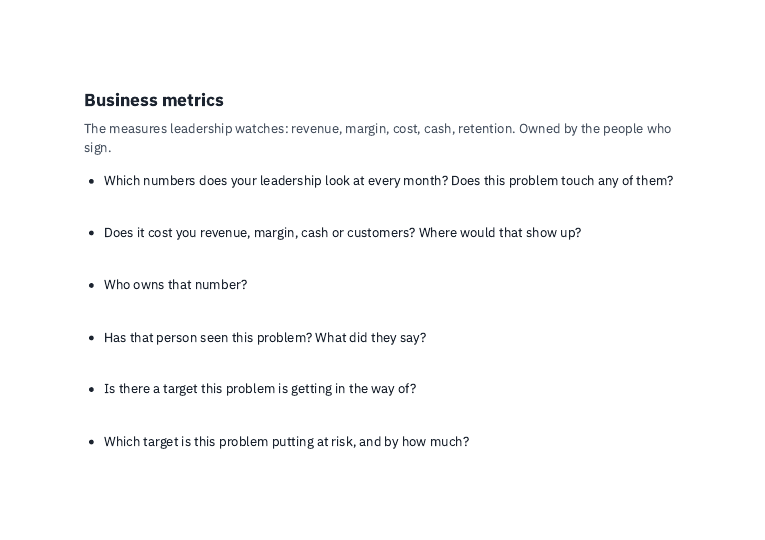
Questions
What format is it?
One download: PDFs, a PowerPoint slide deck and the ebook edition.
Is it about one kind of deal?
No. The three worked examples are a one-off automation build, a three-year subscription deal, and a small build with a monthly retainer and a fee per message. The method is the same for all three.
Where does the canvas fit?
The canvas suits anyone selling something, a product or a service, to someone with a problem. It helps you dig into that problem and explain it in a way that can be quantified. The one place it doesn’t fit is a small transactional deal: if the customer can buy on a card without asking anyone, the canvas is more work than the decision needs.
Three situations where it matters most:
- The buyer won’t share costs. That is exactly when to use it. You need to help them uncover and define the costs, or they won’t move to solve the problem.
- Deep technical discovery and pre-sales work. The canvas isn’t a technical framework, but when you’re about to invest in deep technical discovery and pre-sales costs, defining the fit between the problem and the solution matters even more. Don’t invest those resources unless both sides agree it makes sense, and the canvas is how you confirm that.
- Informing your price. The canvas isn’t a pricing tool, but it informs pricing decisions. If you’re solving a $100,000 problem, don’t sell the solution for $5,000. If it’s only a $5,000 problem, don’t try to engineer a $100,000 solution.
It also doesn’t replace a qualification method such as MEDDICC.
Training a team?
Paul works with sales teams through Work with Paul. Team training is scoped and priced on a first call.
How do refunds work?
See the guarantee below.
The guarantee
If the toolkit doesn’t help, ask for a refund within 30 days of buying. No conditions and no questions. Reply to your receipt or email support@solutionstrategizer.com.
Polar sells the toolkit for us and handles payment, tax and the download. You get the files straight after paying, and your receipt shows the tax for your expense claim.
Who made it

Paul Baillie has worked in enterprise technology since 2003, first running projects and services, then selling cloud and managed services and, more recently, AI infrastructure to large companies. He spent 12 years growing one account from $30m to $110m in annual recurring revenue, and has exceeded quota in each of his 14 years in direct sales. He wrote the canvas down in 2023 to describe the approach he used.
These are Paul’s own results, not a forecast of yours.
Get the toolkit
$79, plus sales tax where applicable, added at checkout. If it doesn’t help, ask for a refund within 30 days, with no conditions.